

At least, to begin with...

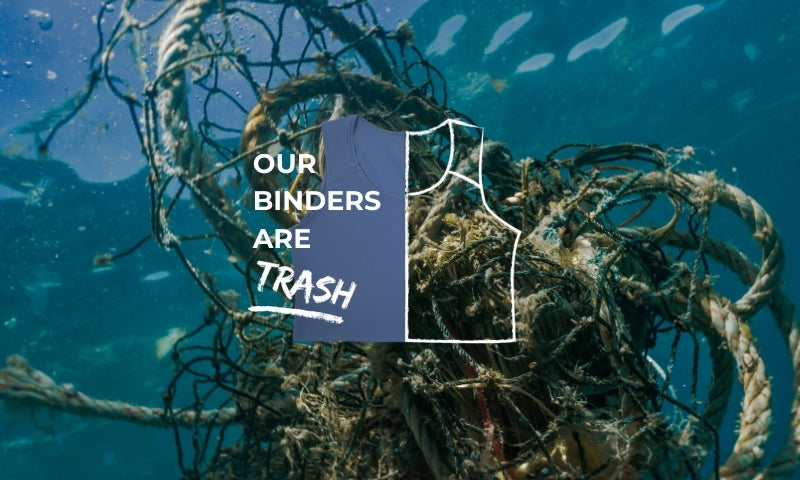
At the very start, our binders begin life as old carpets, second hand garments, industrial waste, and of course fishing nets. They start as one of the most widely used but harmful synthetic polymers: Nylon 6, which is very durable and lightweight making it desirable for fishing nets. Production of Nylon is heavy on greenhouse emissions and energy consumption and creates water and chemical waste which then requires proper management to prevent environmental contamination.
The issue of ocean plastics
Reducing plastics in the oceans is a vital task because of the far-reaching and persistent harmful effects these materials have every year, and the knock-on effects it will have for life on land and the LGBTQ community specifically.

According to Earth.org 100,000 marine animals are killed by ocean plastic ingestion or entanglement each year, and that is aside from the countless number of plankton that are affected.
Every year, an estimated 6.4 million tons of fishing gear are lost in the ocean. A 2022 study by The Ocean Cleanup revealed that the Great Pacific Garbage Patch is largely composed of fishing-related plastic waste.

A lot of this is what is called ‘ghost nets’, or ‘ghost fishing’. This is the name given to fishing nets that have been abandoned in the sea and come in different forms: curtain-like gillnets, massive trawl nets that are dragged by boats, fishing traps and lines.
Ghost fishing is so called for its effect of catching fish long after the boats and people have gone – catching small and large fish which can then attract predators who also become entangled, and sometimes ghost nets can even catch other ghost nets! Ghost fishing is destructive to ocean wildlife and habitats and as the nets degrade, they also create dangerous microplastics.
Plankton and microplastics
What are microplastics? They are extremely small pieces of plastic debris in the environment resulting from the disposal and breakdown of consumer products and industrial waste.

Plankton, especially phytoplankton, are massive contributors to oxygen production on our planet. One species, Prochlorococcus, produces up to 20% of the earth's atmospheric oxygen.
Plankton are tiny creatures that are invisible to the human eye, yet they are hugely important to our planet’s ability to regulate atmospheric carbon. In short, according to the Plastic Pollution Coalition, they protect us from “experiencing the full impacts of our own greenhouse gas emissions” because they generate oxygen and trap carbon from being released into the atmosphere.
Researchers have found that exposure to microplastics damages plankton and prevents them from photosynthesising properly “potentially undermining one of the ocean’s vital processes for removing CO2 from the atmosphere and sustaining our planet’s oxygen levels.”

For the LGBT+ community who are at a higher risk of food insecurity and homelessness the effect of climate change means the healing of the planet is just as vital as our fight for rights, equality, and respect. According to The Journal of Climate Change and Health “Like other marginalized groups, lesbian, gay, bisexual, transgender, and queer (LGBTQ+) people will, on average, have more exposure to climate change-related disasters, be more susceptible to the adverse impacts of climate change-related disasters, and have fewer resources to recover from climate harms.”
Essentially, climate change exacerbates existing socio-economic disparities for example, when a climate disaster like a hurricane causes homelessness, LGBT+ people are disproportionally affected. “US non-profit organisation, True Colours United, found that LBGTQIA+ youth are 120% more likely to experience homelessness, and that just under half of the US homeless population is made up of LBGTQIA+ individuals and transgender people of colour.”
So how are ocean plastics turned into chest binders?
The Healthy Seas Foundation is the charity working to provide our suppliers with the Nylon fishing nets removed from the Atlantic and Pacific Ocean as well as 5 other seas. Since their inception they have gathered 1,228 tons of fishing nets and other marine litter, thanks to the efforts of amazing volunteer divers of Ghost Diving. Please go check them out!
Once Healthy Seas has provided our supplier with the abandoned and disused Nylon it is regenerated through an eco-friendly chemical process, turning it into recycled polyester - the fabric that makes up the outer shell of our binder.
Standard polyester is created by processing crude oil – a fossil fuel. By recycling nylon we’re able to prevent new fossil fuels being used up in this way. Plus, the regenerated nylon is recyclable which means at the end of its use it can be collected and regenerated into brand new Nylon. Trash no more!

Every binder is a result of the incredible work of dozens of people trying to heal the world we live in and it doesn’t end there! With the proceeds from our binders, we then pay it forward to Ecologi, a climate action platform that supports all kinds of environmental restoration projects all over the world.
Ecologi help us to plant one tree with every order, this goes towards wildlife habitat restoration in Colombia and rainforest preservation in the Amazon to name just two. Through our partnership we’ve also been funding renewable energy projects in India, Mexico, Honduras and many others across the globe. You can see more about all the projects that we have contributed to by clicking here.
We are proud to say that we are part of supply chain that makes ecological choices from the sea to the tree, via wonderful volunteers working hard across our seas and our amazing eco-conscious customers.
We hope you will join us in continuing to make choices that protect our oceans, our land and our rights for a better future.
Further reading: